The Ḥāl of Rabīʾ ibn Hādī al-Madkhalī
May Allāh guide the Madākẖilah back to Islām.
Rabīʾ ibn Hādī al-Madkhalī
Rabīʿ ibn Hādī ʿUmayr al-Madkhalī was a contemporary scholar who was promoted by his ignorant followers to be some sort of "master" in the field of Jarḥ and Taʿdīl (Criticism and Praise) of narrators, as well as a committed confuter of misguided sects—his favorite being the "Ḥaddādiyyah". In cases more than one, his ignorant followers choose his position over the position of the Salaf, and end up holding his status above them, and we seek refuge in Allāh.
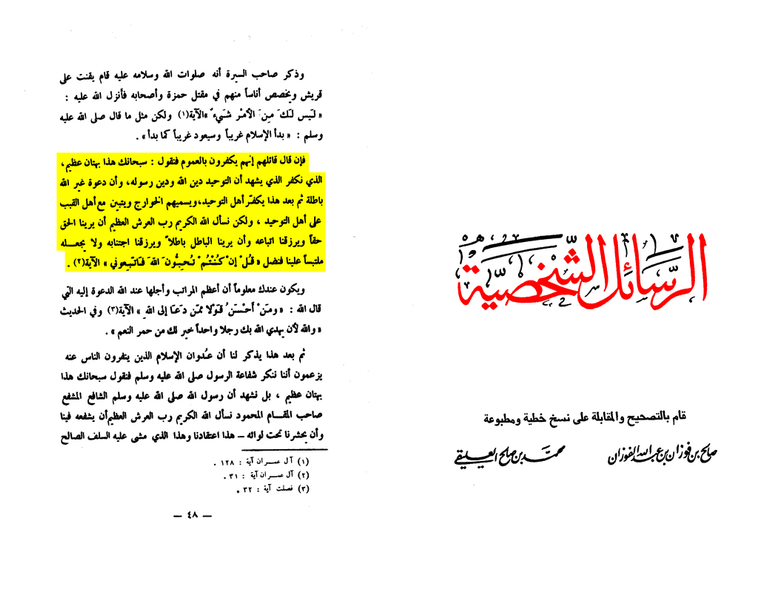
However, in sooth his beliefs and corrupt methodology contain severe deviations, among them being Irjāʿ in Īmān, his very strange rejection on the validity of the ijmāʿ on Tark aṣ-Ṣalāh, and even kufr (involving al-Maqām al-Maḥmūd).
What will follow will be the declaration, and the clarification on his maḏhab, showing his very interesting ideologies, and how twisted he is in his ʿaqīdah.
If you choose to deny after this, and still see him as upon the Sunnah, by Allāh you are lost.

Irjāʾ
"It has become clear through diligent study that the claim of a consensus of the Companions and the Followers on declaring the one who abandons the ṣalāh out of heedlessness and laziness to be a disbeliever has not been established. And that the definition of īmān attributed to al-Shāfiʿī, raḥimahu Allāh, has not been established..."
- To find this, click on the link and search for: "وفي النهاية نقول"
Rabīʾ said in [al-Ḥaddādiyyūn al-Takfīriyyūn yarmūna Ahl al-Sunnah al-Sābiqīn wa-l-lāḥiqīn wa-A’immatahum bi-l-Irjāʾ li-annahum yaqūlūna: “al-īmān aṣl wa-l-ʿamal farʿ.”]:
“Those who say that īmān is the root and that deeds are a branch or part of its perfection are Ahl al-Sunnah wa-l-Jamāʿah...”
- To find this, click on the link and search for: "والذين يقولون إن الإيمان أصل والعمل فرع أو كمال هم أهل السنة"
Rabīʾ said in [Naṣīḥah akhūwiyyah ilā al-akh ash-Shaykh Fāliḥ al-Ḥarbī, p. 38]:
“If anyone says that those who abandon [good] deeds [or all acts of worship] are deficient in faith, or that those who commit major sins are deficient in faith, it is not correct to say that he has agreed with the Murji'ah.”
Rabīʾ said in [A blog containing his statements]:
“So leave off arguing about the condition of perfection, for there is no difference between saying ‘[deeds] are from perfection’ and the statement of one who says: ‘Action is a condition of perfection.’ And Shaykh al-Islām [Ibn Taymīyyah] has many statements that action is perfection, and īmān is the foundation.”
Rabīʾ said in [Kalimah fī al-Tawḥīd wa-Taʿlīq ʿalā baʿḍ Aʿmāl al-Ḥaddādiyyah al-Jadīdah]:
“Many scholars say: ‘Īmān is the root and actions are perfection,’ or, ‘actions are branches.’ They say this. Shall we label them Murjiʾah? I seek refuge in Allāh from that.”
Rabīʾ said in [al-Ḥaddādiyyah tatasqaṭu al-Āthār al-Wāhiyah wa-l-Uṣūl al-Fāsidah, wa-hadafuhā min dhālika taḍlīlu Ahl al-Sunnah al-Sābiqīn wa-l-Lāḥiqīn.]:
"I indeed fear that Ibn Baṭṭah’s statement declaring the one who abandons the ṣalāh to be a disbeliever may have been inserted into his book al-Ibānah al-Kubrā."
And in his commentary on al-Ājurrī’s statement:
“This is a clarification for those who understand, that it is known the religion is not valid except by belief in the heart, verbal affirmation with the tongue, and action with the limbs—such as prayer, zakāh, fasting, ḥajj, jihād, and similar matters”
— he (Rabīʿ al-Madkhalī) said:
“That is: of the various forms of righteousness and goodness, and avoiding the forbidden and disliked matters and the like. The religion is not complete, and we do not uphold it in a complete manner, except if we fulfill it in all these aspects: belief in the heart, affirmation with the tongue, and action with the limbs.”
—📚 adh-Dharīʿah ilā Bayān Maqāṣid Kitāb ash-Sharīʿah, vol. 1, pp. 509-510
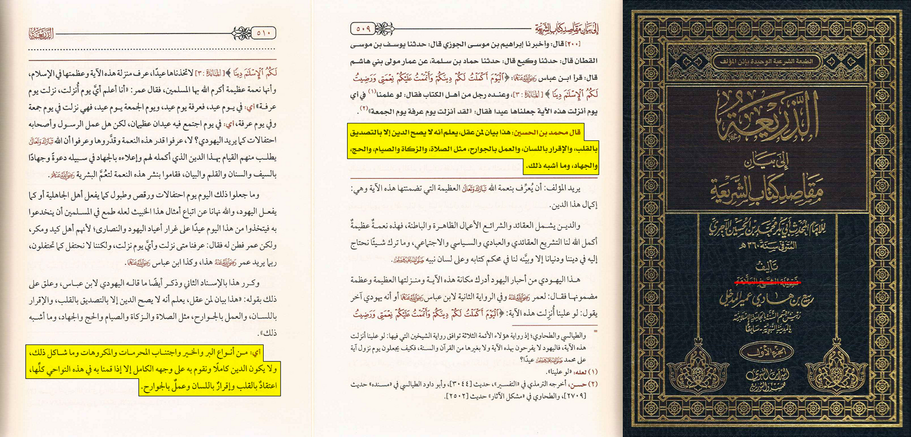
In his commentary on al-Ājurrī’s Kitāb ash-Sharīʿah, Rabīʿ begins by citing the established definition that the dīn is not valid except with belief in the heart, verbal affirmation, and actions of the limbs, like ṣalāh, zakāh, ṣawm, ḥajj, and jihād—exactly as the Salaf held that īmān comprises all three.
Yet he then reinterprets the “actions” to mean general righteousness and avoidance of prohibited or disliked matters, concluding that the dīn is not complete without them, rather than not valid. This shift from ṣiḥḥah (validity) to kamāl (completion) amounts to excluding action from the essence of īmān and keeping it only for perfection.
That is precisely irjāʾ: maintaining the name of Islām for one who abandons all outward deeds so long as heart-belief and verbal affirmation remain. This view is in contradiction to the clear view he quoted and to the known uṣūl of the Salaf that action is part of īmān’s definition, not merely its 'perfection'.
Retardation
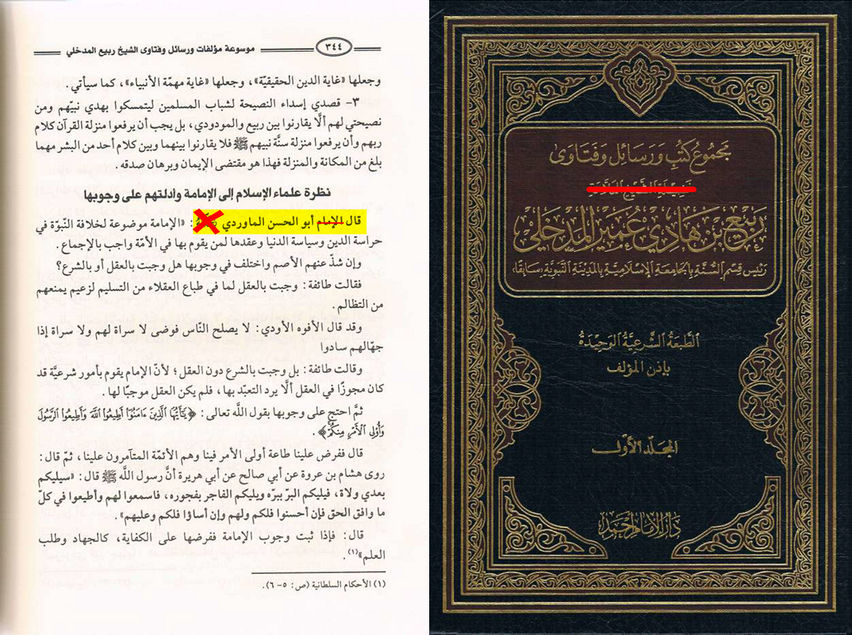
ImamAbū al-Ḥasan al-Māwardī,may Allāh have mercy on him, said...
Taken from here:
Then He istawā (rose/established) over the Throne’ has two interpretations: First: it means His command/authority settled upon the Throne. Second: it means He conquered (istawlá) the Throne, as the poet said: ‘Bishr has conquered Iraq without sword or bloodshed.’”)
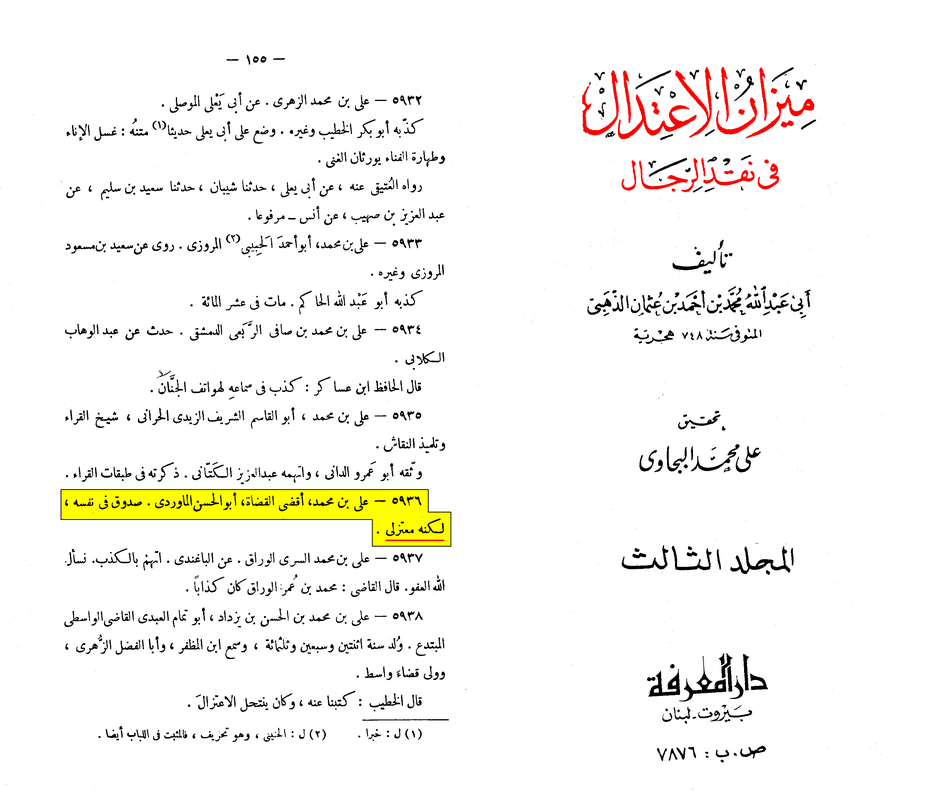
ʿAlī ibn Muḥammad, the chief judge, Abū al-Ḥasan al-Māwardī. Honest in himself, but he is an Muʿtazilī.
—📚 al-Mīzān al-Iʿtidāl fī Naqd ar-Rijāl vol. 3, p. 155
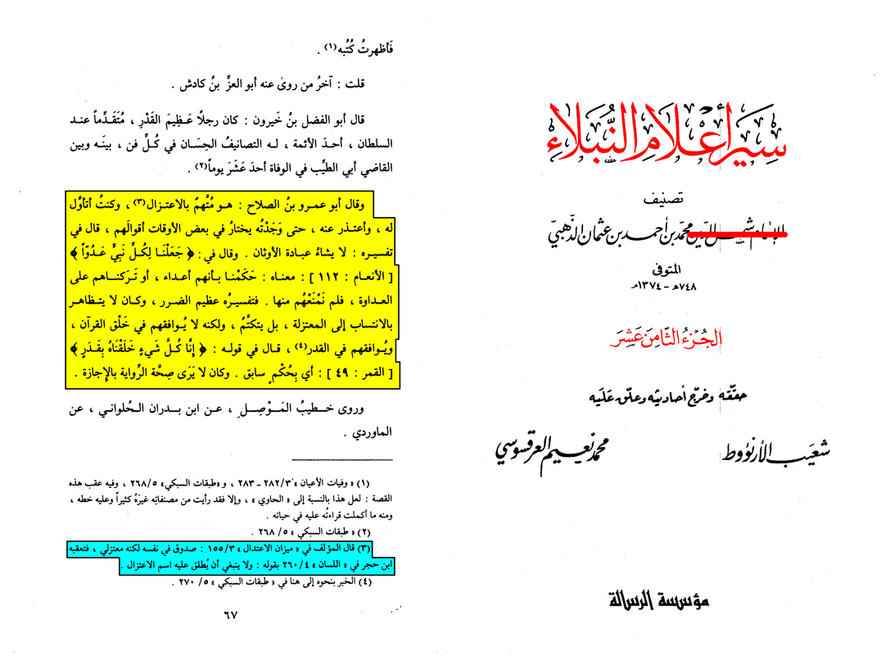
Abū ʿAmr ibn al-Ṣalāḥ said:
He was thought to have Iʿtizāl, I used to defend him and excuse him, until I found that at times he chose their views.
In his tafsīr he said: ‘[Allāh] does not will the worship of idols.’ And about {We made for every prophet an enemy} (6:112) he said: it means ‘We judged them to be enemies,’ or ‘We left them on their enmity and did not stop them.’ His explanations cause great harm.
He did not show openly that he was Muʿtazilī; he hid it. He did not agree with them that the Qurʾān is created, but he did agree with them about qadar. About {Indeed, We created everything by decree} (54:49) he said: ‘by a prior ruling.’
And he did not see reporting ḥadīth only by ijāzah (permission) to be valid.
—📚 Siyar ʿAlām an-Nubalāʿ - vol. 18, p. 67
Ṣāliḥ ibn ʿAbd al-ʿAzīz Āl Shaykh was asked about the creed of al-Māwardī, as mentioned in al-Farq bayna Kutub al-Ḥadīth wa Kutub al-Fiqh:
Question: What is the creed of al-Māwardī, and what is your opinion regarding his book Al-Aḥkām al-Sulṭāniyyah?
Answer: al-Māwardī is Ashʿarī, and he was accused of iʿtizāl. He is the author of the tafsīr al-Nukat wa al-ʿUyūn, which was published in Kuwait and later elsewhere. He was accused of iʿtizāl in some matters, but overall, he is Ashʿarī in creed. His book al-Aḥkām al-Sulṭāniyyah, with regard to the imāmah (leadership) and the enjoining of good and forbidding evil, is inaccurate and does not conform to the detailed positions of the Salaf.
Taken from here and can also be found here
I say:
This is all I will show regarding al-Māwardī, there are more flaws in his tafsir, and why he was accused of such, but the point goes back to Rabīʿ doing taraḥḥum on him. Before I move on, him being Ashʿari is one of the key points here due to the fact there were many narrations among the Salaf regarding how they treated the Ashāʿirah. See here and here. I hope this makes sense.
"ImāmMuḥammad ibn al-Ḥasan al-Shaybānī, the companion of Abū Ḥanīfah,رحمهما اللَّه, said..."
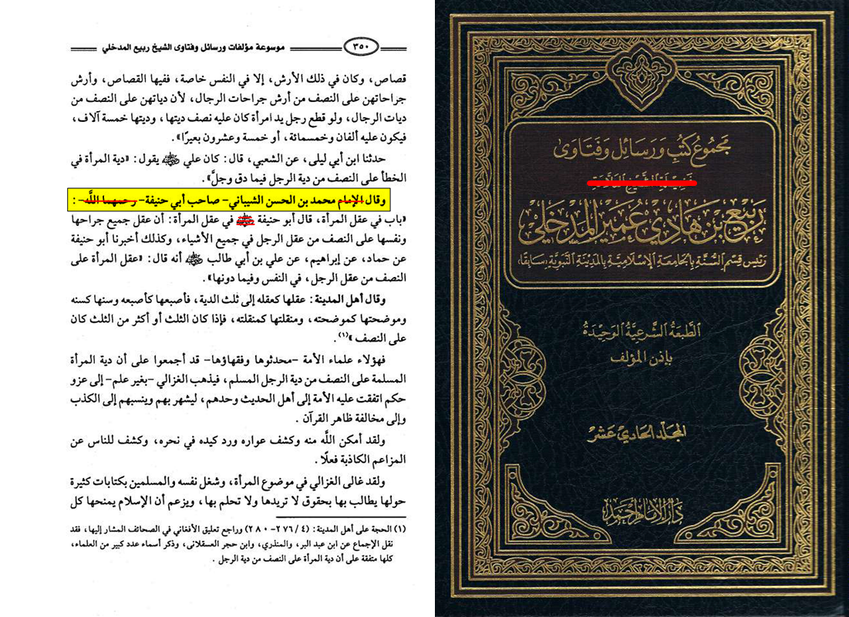
al-ʿAtīqī reported to us, Tammām ibn Muḥammad ibn ʿAbd Allāh al-Rāzī in Damascus narrated to us; Abū al-Maymūn ʿAbd al-Raḥmān ibn ʿAbd Allāh al-Bajalī said: I heard Naṣr ibn Muḥammad al-Baghdādī say:
I heard Yaḥyā ibn Maʿīn declare:
“Muḥammad ibn al-Ḥasan [al-Shaybānī] was a liar (kadhdhāb) and a Jahmī; while Abū Ḥanīfah was a Jahmī, he was not a liar.”
—📚 Tārīkh al-Baghdād, vol. 15, p. 580
My brother made this regarding the isnād and tawthīq of this narration, check it out as it clarifies the "weak links".
Kufr
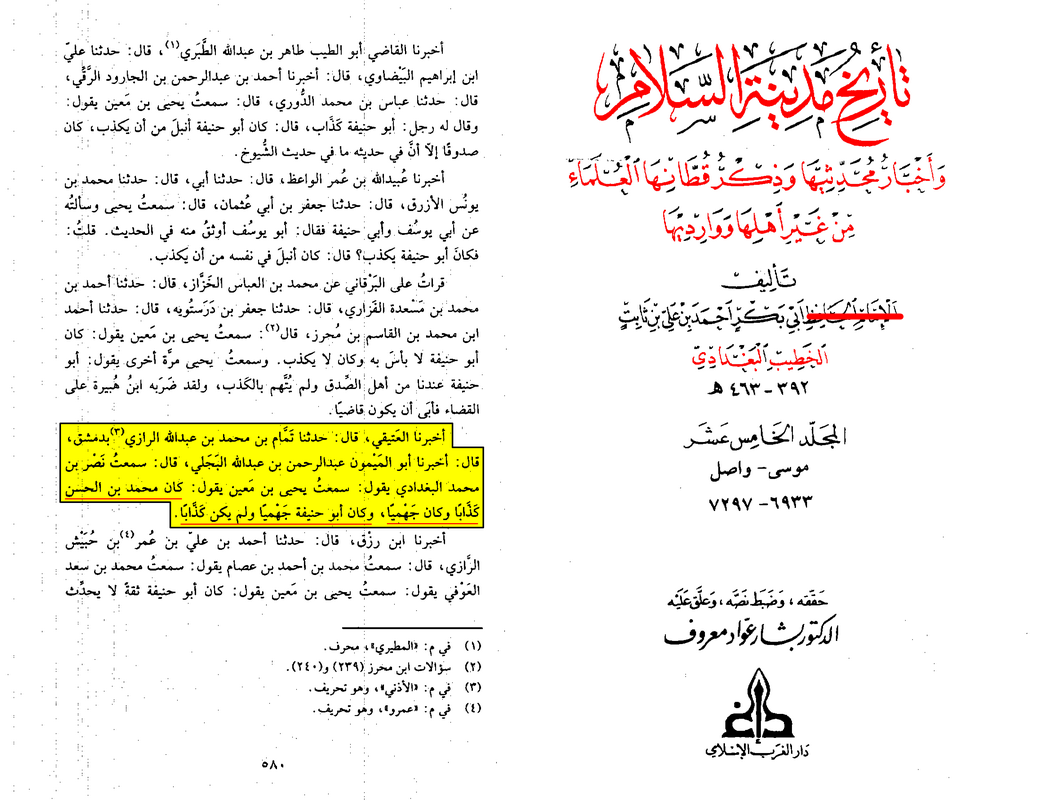
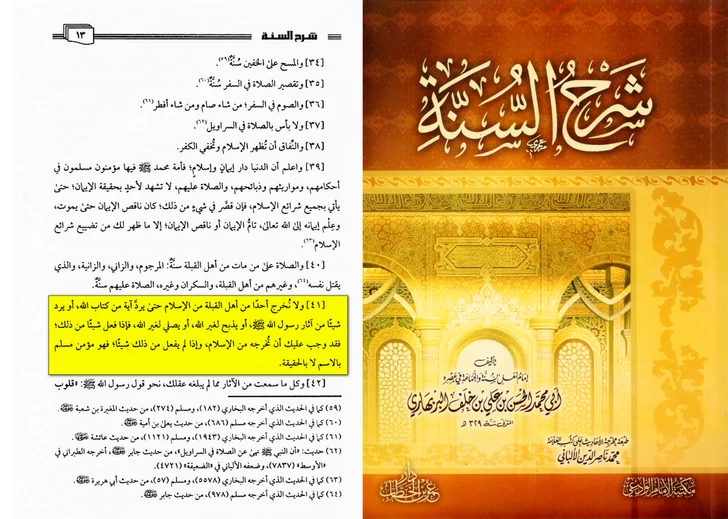
He said in his commentary of Sharḥ as-Sunnah:
This is not correct according to Mujāhid, and it is not established, nor is it from the words of the Noble Messenger صلى الله عليه وسلم. Had the Messenger of Allāh informed us that he reached the Throne and sat upon it, there would be nothing in the Sharīʿah or in sound reason to prevent it. However, the ḥadīth has not been established for us; we do not believe in it or accept it as part of our religion unless it is proven by authentic evidence from the Prophet صلى الله عليه وسلم. As for the statement of Mujāhid—may Allāh forgive him—it is possible that he took it from the Isrāʾīliyyāt.
—📚 ʿAwn al-Bārī bi-Bayān mā Taḍammnahu Sharḥ as-Sunnah lil-ʿImām al-Barbahārī - vol. 1, pp. 453-454
I say: The refutation will be at the end of the [REFUTATIONS] section.
</div> </div> He also said [which can be found here]:
“We do not declare these misguided people to be disbelievers, but they are misguided and have destroyed the Ummah. We will not declare them to be disbelievers until proof is established against them, because of what they do, such as calling upon others besides Allāh, which is the worst kind of shirk; sacrificing animals for others besides Allāh; and seeking aid from others besides Allāh, which is also the worst kind of shirk. In fact, they have gone further than this, they believe that saints know the unseen and control the universe.”
📘 From a lecture entitled Ḥuqūq Allāh al-ʿAzīmah (The Great Rights of Allāh)
Rabī' said:
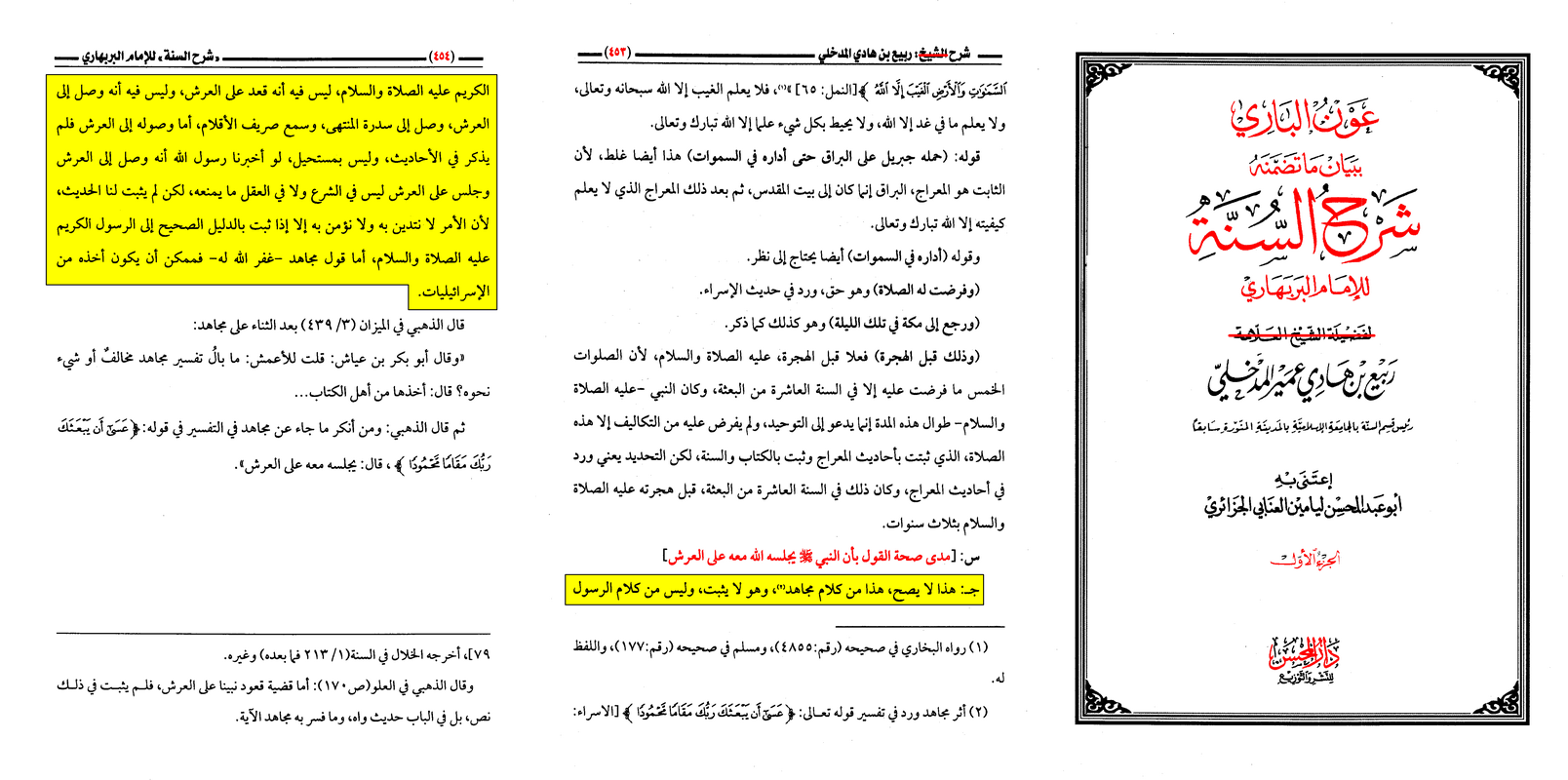
“You go to the people of the graves and say, ‘Īmān! Īmān!’, they clap for you. But say: ‘Al-Badawī is not to be invoked; ar-Rifāʿī is not to be invoked; no slaughtering is to be done for him; no vows are to be made for him’, they fight you. {“And when Allāh Alone is mentioned, the hearts of those who believe not in the Hereafter are filled with disgust; and when those (whom they worship) besides Him are mentioned, behold, they rejoice!”} [Az-Zumar 39:45]. This is an old and ongoing rule among the people of misguidance. Even so, we do not declare these wretched types, who have harmed Islām and disfigured it by their stances and their misguided, polytheistic understandings, and the like, to be disbelievers until the ḥujjah is established against them and their doubts are removed.”
—📚 al-Dharīʿah ilā Bayān Maqāṣid Kitāb ash-Sharīʿah, vol. 1, p. 555
Rabī' said:
“Most Muslim scholars in the time of Shaykh Muḥammad [ibn ʿAbd al-Wahhāb] and in our own day say that tabarruk (seeking blessing) through the righteous and tawassul (seeking a means to Allāh) by them is permissible; yet they use the term tabarruk in an unqualified, ambiguous way—the way of the people of innovation. So what do you mean by tabarruk?
—📚 Dahru Iftirāʾāt Ahl al-Zaygh wa-l-Irtiyāb, p. 141If by it you intend istighāthah (calling upon other than Allāh for rescue), or slaughtering and making vows to other than Allāh, then this is major shirk. If such people deem this tabarruk permissible, then whoever the ḥujjah (proof) has been established against, yet acts obstinately, stubbornly persists, and supports this major shirk, is a polytheist. But if he is ignorant, he is to be taught, and he is not declared a disbeliever until the ḥujjah is established against him.”
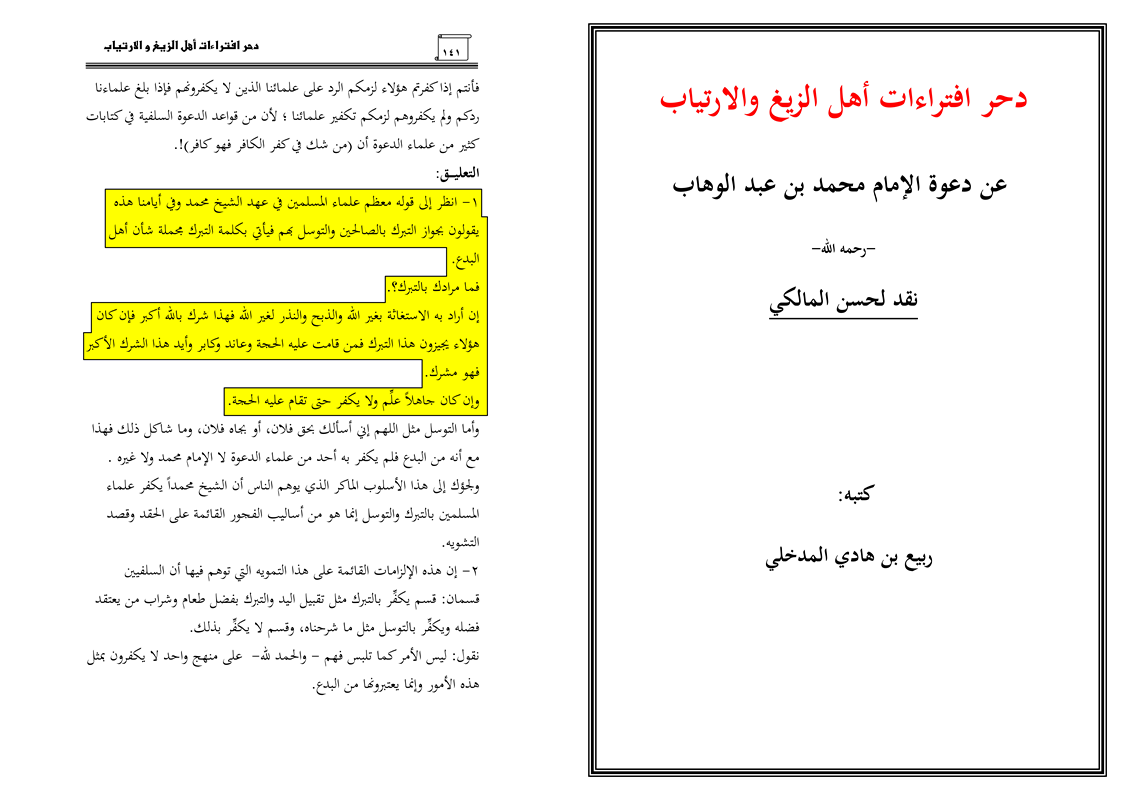
Rabī' said:
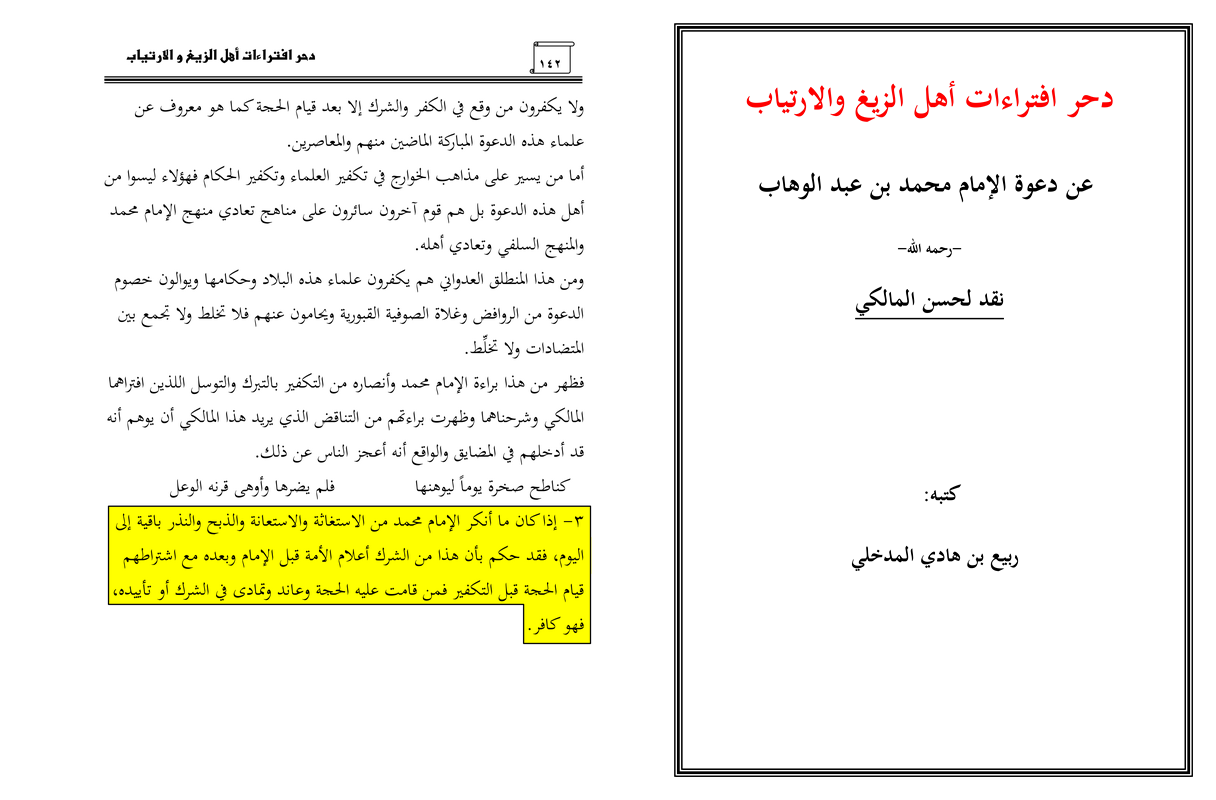
"If what Imām Muḥammad rejected al-istighāthah, al-istiʿānah, al-dhabḥ, and al-nadhar remains in force to this day, then the leading scholars of the Ummah, before the Imām and after him, have ruled that this is shirk, while stipulating that the ḥujjah must be established before declaring takfīr. So whoever the proof is established against, and who resists, and persists in shirk or in supporting it, then he is a kāfir"
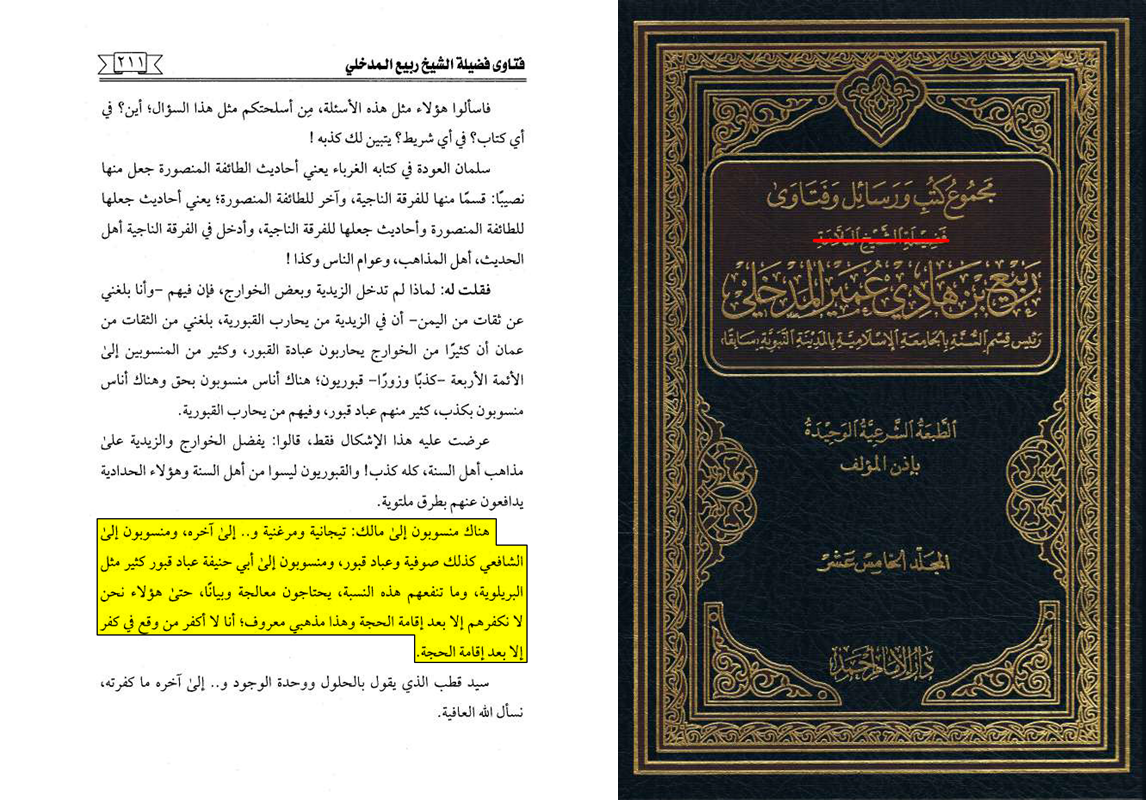
“There are people who ascribe themselves to Mālik—the Tijāniyyah, the Mirghaniyyah, and so on, and people who ascribe themselves to ash-Shāfi'ī—that are the Sūfīyyah and grave worshippers, and people who ascribe themselves to Abū Ḥanīfah; grave-worshipers are many, such as the Baraylawiyyah (Barelvis). This ascription does not benefit them. They need to be addressed and the truth clarified to them. Even these—we do not declare them disbelievers except after establishing the proof. And this is my well-known position: I do not declare takfīr upon one who has fallen into kufr except after establishing the proof.”
Refutations
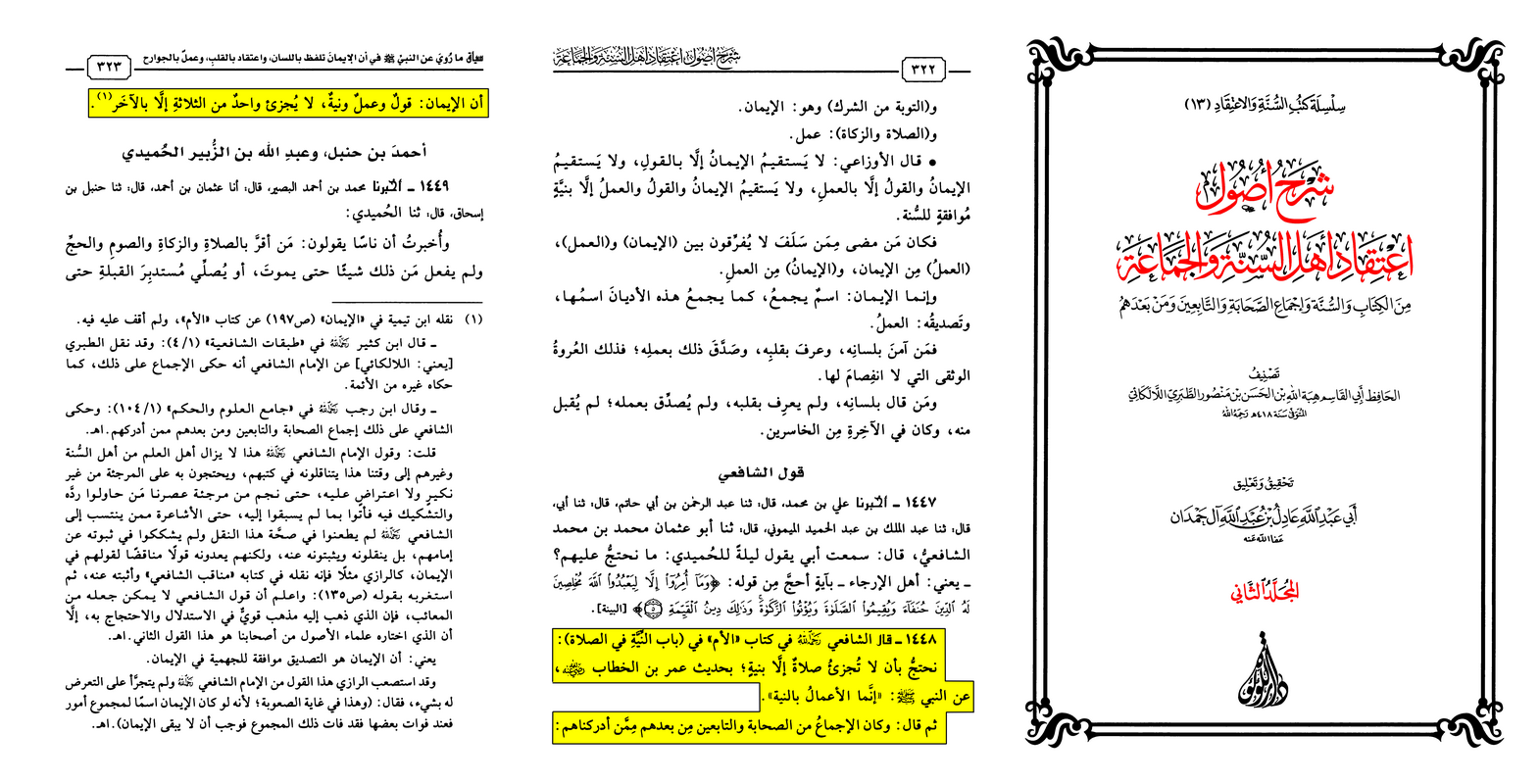
ash-Shāfiʿī, may Allāh have mercy on him, said in al-Umm, in the chapter on the intention in prayer:
It is correct that no prayer is valid except with intention, as reported from ʿUmar ibn al-Khaṭṭāb from the Prophet ﷺ: “Indeed, actions are by intentions.”
Then he said:
There was consensus among the Companions and the Tābiʿīn from those who met them, that īmān is: statement, action, and intention, none of the three are valid without the others.
— 📚 Sharḥ Uṣūl ʿIʾtiqād Ahl as-Sunnah wal-Jamā'ah - vol. 2, pp. 322-323, n° 1448.
As for the ruling on Tark aṣ-Ṣalāh, I will take it all from the book of al-Imām al-Ājurrī رحمه الله
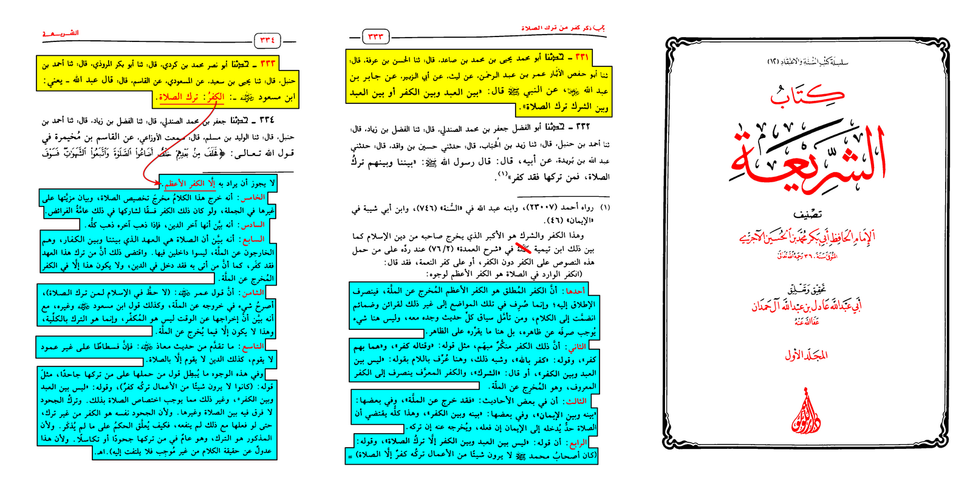
331 — Abū Muḥammad Yaḥyā ibn Muḥammad ibn Ṣāʿid narrated to us, he said: al-Ḥasan ibn ʿArafah narrated to us, he said: Abū Ḥafṣ al-Abbār ʿUmar ibn ʿAbd al-Raḥmān narrated to us, from Layth, from Abū az-Zubayr, from Jābir ibn ʿAbd Allāh رضي الله عنه, from the Prophet ﷺ who said:
"Between the servant and kufr, or between the servant and shirk, is the abandonment of the prayer."
333 — Abū Naṣr Muḥammad ibn Kurdi narrated to us, he said: Abū Bakr al-Marwazī narrated to us, he said: Aḥmad ibn Ḥanbal narrated to us, he said: Yaḥyā ibn Saʿīd narrated to us, from al-Masʿūdī, from al-Qāsim, he said: ʿAbd Allāh said, meaning Ibn Masʿūd رضي الله عنه:
“al-Kufr is abandoning the prayer.”
FOOTNOTES
First: The unqualified term kufr refers to the greater kufr that expels a person from the millah (the religion). The wording should be taken as referring to that. In those other contexts it was diverted to something else only because of accompanying indicators and additions attached to the speech; anyone who reflects on each ḥadīth’s context will find them present. Here there is nothing that requires diverting it from its apparent sense—indeed, here there is what confirms the apparent sense.
Second: That kufr there is indefinite and ambiguous, like his statement: “and fighting him is kufr,” and his statement: “kufr in Allāh,” and the like. Here, however, it is defined with the definite article in his words: “there is nothing between the servant and the kufr,” or “the shirk.” The defined kufr is to be understood as the known (major) kufr, the one that expels from the millah.
Third: In some narrations it says, “he has left the millah”; in some, “between him and īmān”; and in some, “between him and kufr.” All of this entails that the prayer is a boundary: if he performs it, it admits him into īmān; and if he leaves it, it removes him from it.
Fourth: His statement, “There is nothing between the servant and kufr except leaving the prayer,” and his statement, “The Companions of Muḥammad ﷺ did not consider any deed, the abandonment of which is kufr, except the prayer.” It is not permissible to interpret this as anything other than the greater kufr.
Fifth: This wording comes to single out the prayer and to show its virtue over the rest of the obligations in general. If that kufr were mere fisq (sinful defiance), then the rest of the obligations that share its nature would have shared in that ruling.
Sixth: He clarified that it is the last part of the religion; when its last part goes, all of it goes.
Seventh: He clarified that the prayer is the covenant between us and the disbelievers, those outside the millah, not those within it. It follows that whoever abandons this covenant has disbelieved, just as whoever fulfills it has entered the religion. This applies only to the kufr that expels from the millah.
Eighth: The statement of ʿUmar, raḍiya Allāhu ʿanhu, “No share in Islām belongs to one who abandons the prayer,” is the clearest text indicating that such a person has left the millah. Likewise is the statement of Ibn Masʿūd, raḍiya Allāhu ʿanhu, and others. It also clarifies that performing the prayer outside its time is not the disbelief; rather, disbelief is leaving it entirely, and that alone is what expels from the millah.
Ninth: As has preceded in the ḥadīth of Muʿādh, raḍiya Allāhu ʿanhu: just as a roof without a pillar cannot stand, likewise the religion does not stand except by the prayer.
In these points is that which refutes the claim of those who restrict the texts to one who abandons the prayer out of denial. They cite statements such as: “They did not regard anything among deeds, the abandonment of which is kufr, except the prayer,” and: “There is nothing between the servant and kufr,” and the like—texts that actually necessitate singling out the prayer with this ruling. Abandonment “out of denial” would not distinguish the prayer from other acts, and denial itself is kufr without any abandonment—were he even to perform the prayer along with denial, it would not benefit him. So how could the ruling be attached to something not mentioned? What is mentioned is abandonment, and that is general for whoever abandons it, whether out of denial or out of laziness. Diverting the wording from its true claim without any warrant is invalid and should not be heeded.
📚 Kitāb ash-Sharīʿah - vol. 1, pp. 333-334
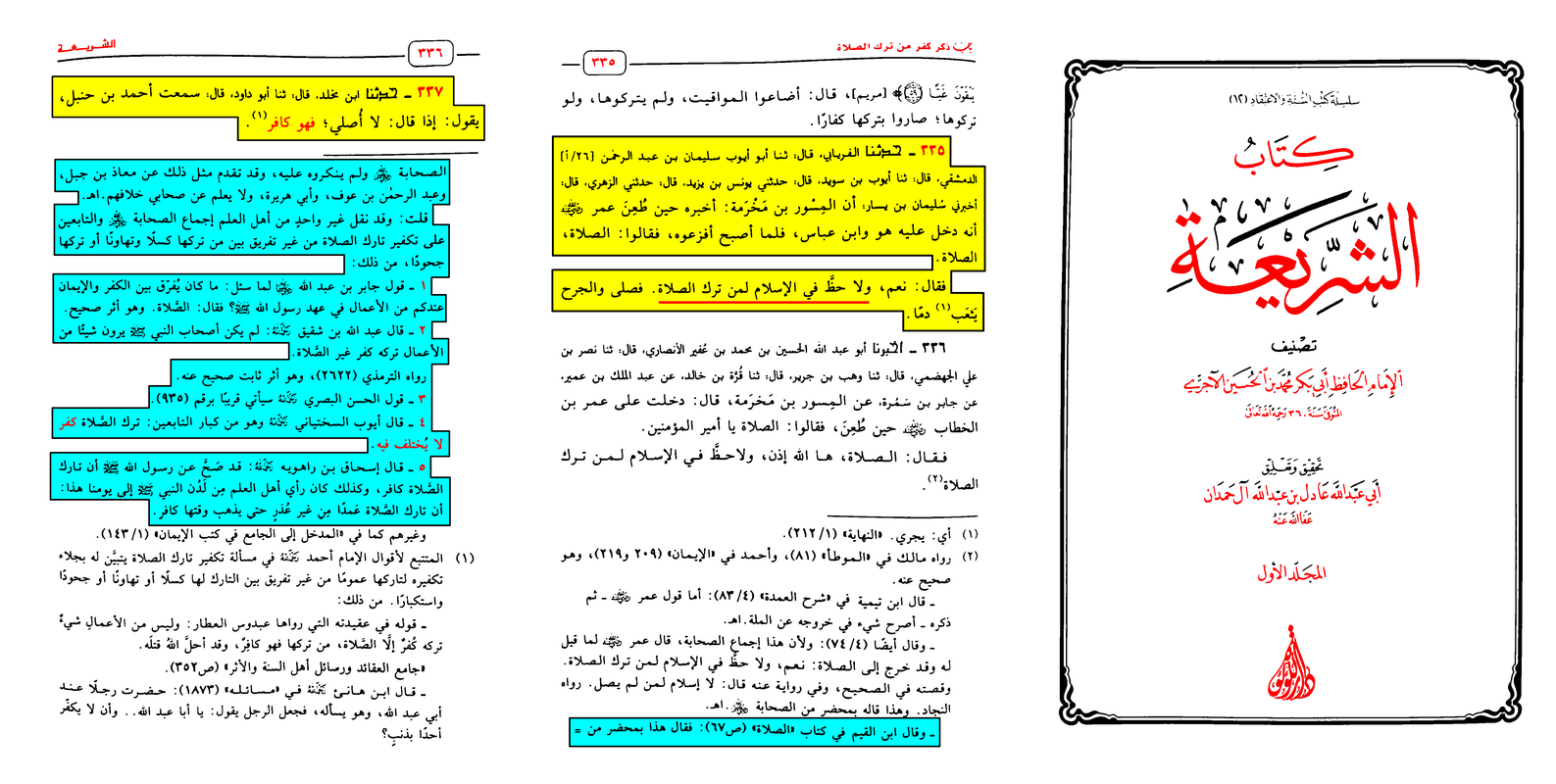
“The prayer, the prayer!”He said:
“Yes. And there is no share in Islām for the one who abandons the prayer.”So he prayed while the wound was gushing blood.
337 — Ibn Mukhallad narrated to us. He said: Abū Dāwūd said: I heard Aḥmad ibn Ḥanbal say:
If a man says, “I will not pray,” then he is a disbeliever.
FOOTNOTES
And Ibn al-Qayyim said in the book al-Ṣalāh (p. 67): He said this in the presence of the Companions, may Allāh be pleased with them, approved this and did not object to it. Similar has preceded from Muʿādh ibn Jabal, ʿAbd al-Raḥmān ibn ʿAwf, and Abū Hurayrah, and no disagreement from any Companion is known.
[ʿĀdil Āl Ḥamdān] I say:
More than one of the scholars has transmitted the consensus of the Companions, may Allāh be pleased with them, and the Followers, that the one who abandons the prayer is a disbeliever, without differentiating between one who leaves it out of laziness and negligence or one who leaves it out of denial. Of that are:
The statement of Jābir ibn ʿAbd Allāh, may Allāh be pleased with them both, when he was asked: What was it that separated disbelief and faith among you, from the deeds, in the time of the Messenger of Allāh صلى الله عليه وسلم? He said: The prayer. This report is authentic.
ʿAbd Allāh ibn Shaqīq said: The Companions of the Prophet صلى الله عليه وسلم did not consider anything from the deeds, the abandonment of which is disbelief, except the prayer. Reported by al-Tirmidhī (2622), and it is a firmly established authentic report from him.
The statement of al-Ḥasan al-Baṣrī will come shortly under no. 935.
Ayyūb al-Sakhtiyānī, one of the senior Tābiʿīn, said: Abandoning the prayer is disbelief in which there is no disagreement.
Isḥāq ibn Rāhūyah said: It has been authentically established from the Messenger of Allāh صلى الله عليه وسلم that the one who abandons the prayer is a disbeliever, and this was likewise the view of the people of knowledge from the time of the Prophet صلى الله عليه وسلم up to our day, that whoever deliberately leaves the prayer without excuse until its time passes is a disbeliever.
📚 Kitāb ash-Sharīʿah - vol. 1, pp. 335-336
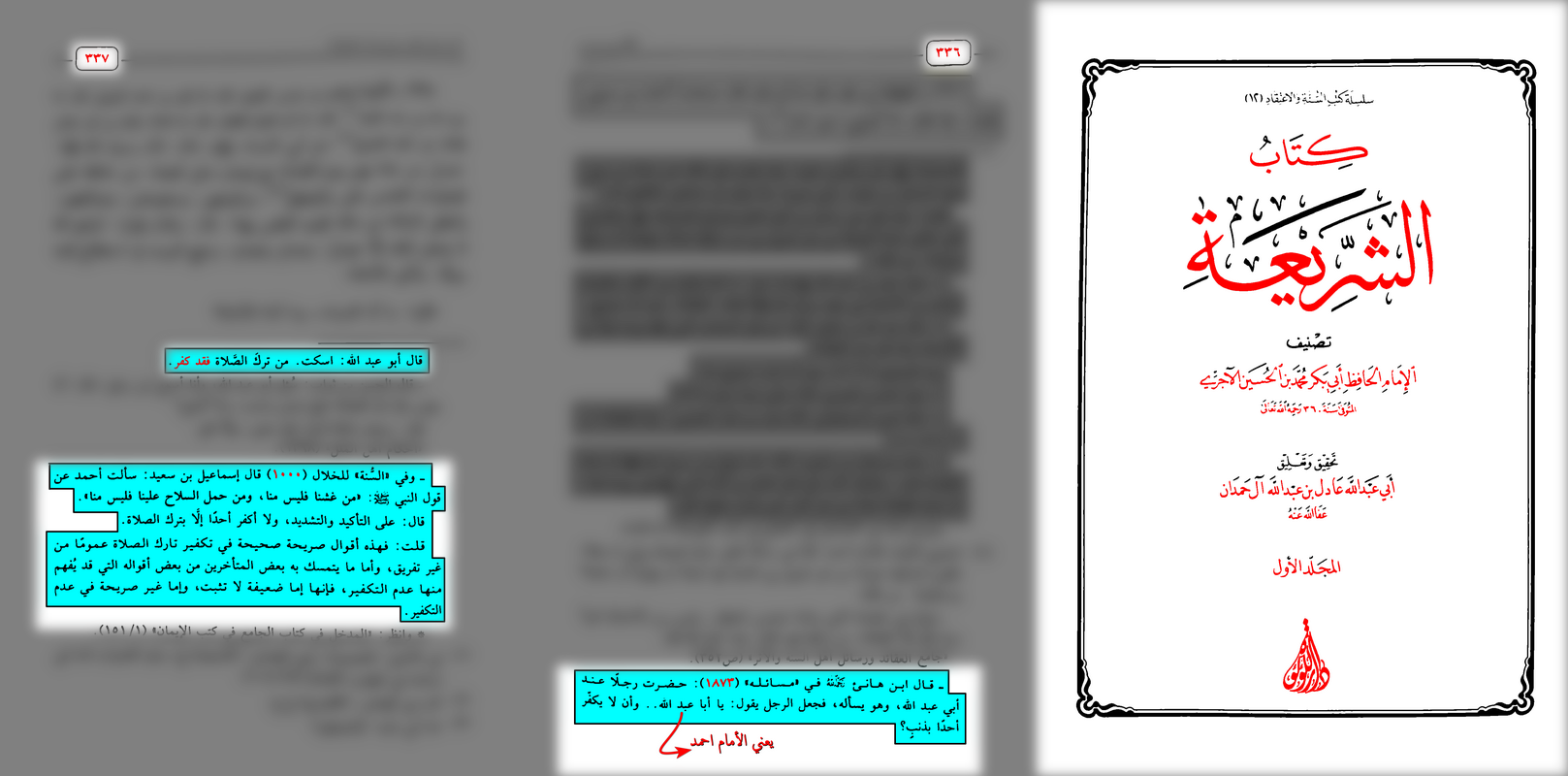
Ibn Hāniʾ, may Allāh have mercy on him, said in his Masāʾil (no. 1873):
“I was present with a man in the company of Abū ʿAbd Allāh while he was questioning him, and the man kept saying: ‘O Abā ʿAbd Allāh … and that no one is declared a disbeliever because of a sin?’”
Abū ʿAbd Allāh (meaning al-Imām Aḥmad) said:
“Be quiet. Whoever abandons the prayer has indeed disbelieved.”
And in al-Sunnah by al-Khallāl (no. 1000), Ismāʿīl ibn Saʿīd said:
“I asked Aḥmad about the Prophet’s statement صلى الله عليه وسلم: ‘Whoever cheats us is not of us, and whoever carries a weapon against us is not of us.’ He said: [These wordings are] for emphasis and stern warning, and I do not declare anyone a disbeliever except for abandoning the prayer.”
[ʿĀdil Āl Ḥamdān] I say:
These are explicit, sound statements affirming the takfīr of the one who abandons the prayer, generally and without distinction. As for what some later scholars cling to from some of his statements from which non-takfīr might be understood, they are either weak and not established, or they are not explicit in negating takfīr.
📚 Kitāb ash-Sharīʿah - vol. 1, pp. 336-337
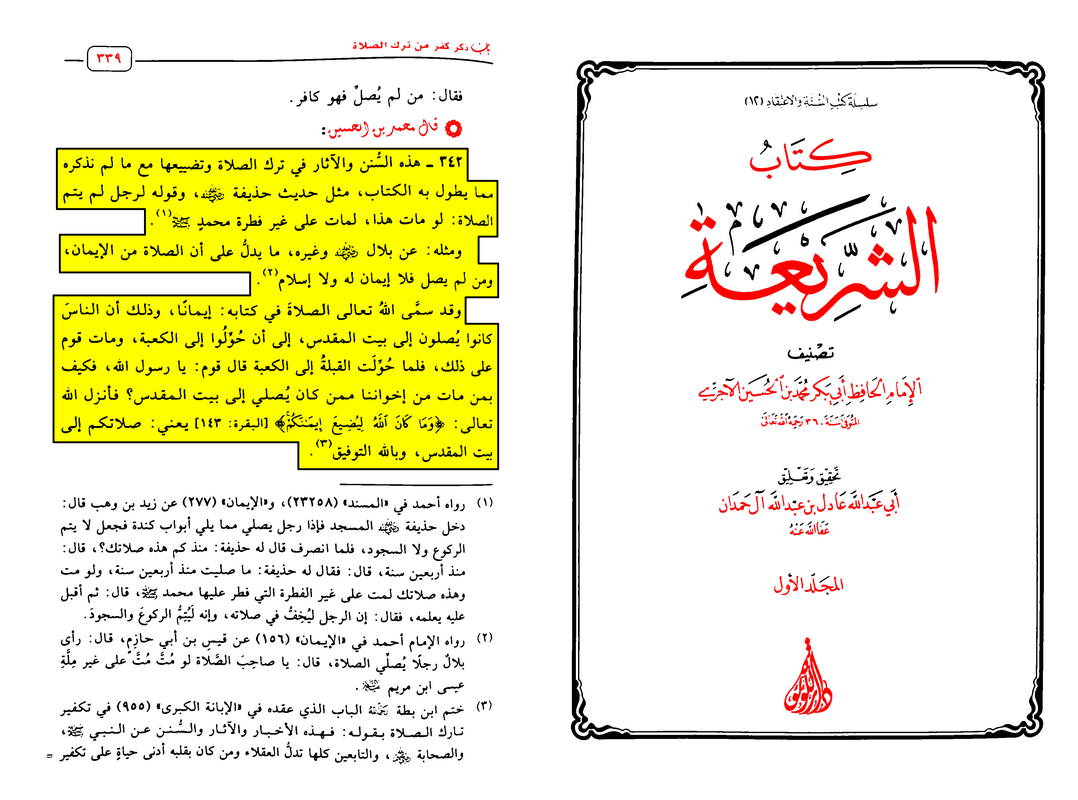
al-Imām al-Ḥāfiẓ Abū Bakr Muḥammad ibn al-Ḥusayn al-Ājurrī, may Allāh have mercy on him, said:
342 — These Sunan and āthār about abandoning and neglecting the prayer, together with much else we have not cited so the book does not grow too long, include the ḥadīth of Ḥudhayfah, may Allāh be pleased with him, and his statement to a man who did not perfect his prayer: “If this one were to die, he would die upon other than the fiṭrah of Muḥammad ﷺ.” And likewise reports from Bilāl, may Allāh be pleased with him, and others- indicating that the prayer is part of īmān; and whoever does not pray has neither īmān nor Islām.
And Allāh, Exalted is He, has called the prayer “īmān” in His Book: the people used to pray toward Bayt al-Maqdis until they were directed to the Kaʿbah, and some people died upon that. When the qiblah was changed to the Kaʿbah, some said: “Messenger of Allāh, what about our brothers who died while praying toward Bayt al-Maqdis?”
So Allāh [Glorified and Exalted is He] revealed: {And Allāh would never cause your īmān to be lost} [al-Baqarah 2:143], meaning: your prayers toward Bayt al-Maqdis.
And with Allāh is success.
📚 Kitāb ash-Sharīʿah - vol. 1, p. 339
And a brother of mine, Muwwaḥid al-Ashūrī, has made an article regarding the consensus on Tark aṣ-Ṣalāh.
https://justpaste.it/tarkalsalah
May Allāh have mercy on him, and reward him for his effort.
Allāh عز وجل said regarding those who associate with him in worship:
And He, the Exalted said:Those who say, “Allāh is the Messiah, son of Mary,” have certainly fallen into disbelief. The Messiah ˹himself˺ said, “O Children of Israel! Worship Allah—my Lord and your Lord.” Whoever associates others with Allah ˹in worship˺ will surely be forbidden Paradise by Allah. Their home will be the Fire. And the wrongdoers will have no helpers.
— al-Mā'idah 5:72
Indeed, those who disbelieve from the People of the Scripture and the polytheists will be in the Fire of Hell.
— al-Bayyinah 98:6
And He, the Exalted said:
Whoever invokes, besides Allāh, another god—for which they can have no proof—they will surely find their penalty with their Lord. Indeed, the disbelievers will never succeed.
— al-Mu'minūn 23:117
And He, the Exalted, revealed about Luqmān saying:
And ˹remember˺ when Luqmān said to his son, while advising him, “O my dear son! Never associate ˹anything˺ with Allāh ˹in worship˺, for associating ˹others with Him˺ is truly the worst of all wrongs.”
— Luqmān 31:13
And He, the Exalted, said:
And most of them believe not in Allāh except that they attribute partners unto Him [i.e. they are Mushrikūn i.e. polytheists.]
— Yūsuf 12:106
And He, the Mighty and Majestic, said:
Certainly you ˹disbelievers˺ and whatever you worship instead of Allāh will be the fuel of Hell. You are ˹all˺ bound to enter it.
— al-Anbīyāʾ 23:98
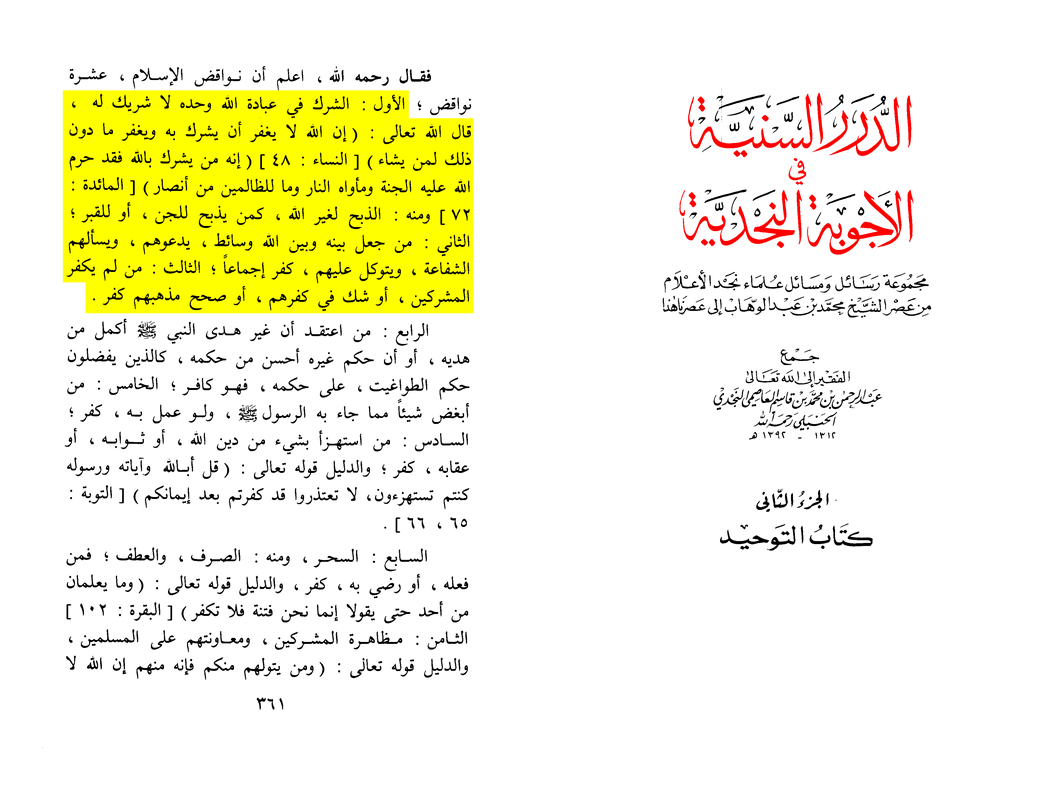
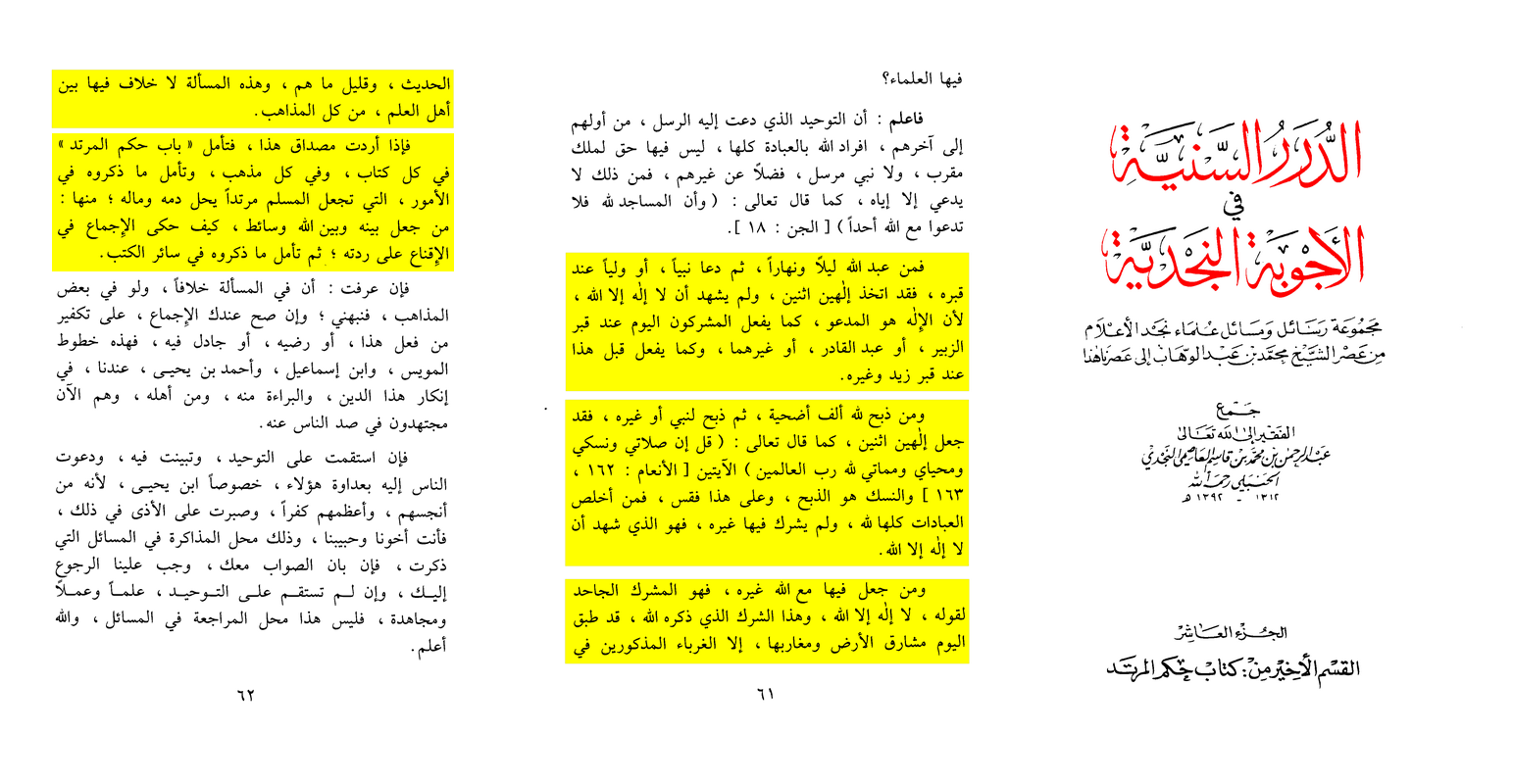
—📚 ad-Durar as-Sanīyyah vol. 10, pp. 404-405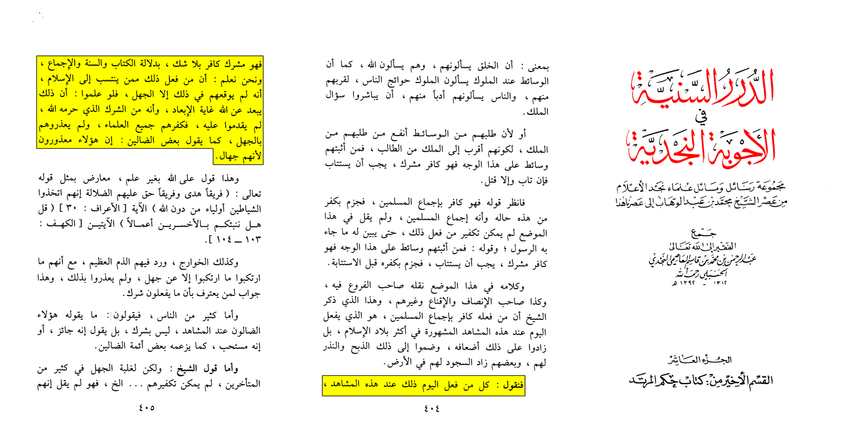
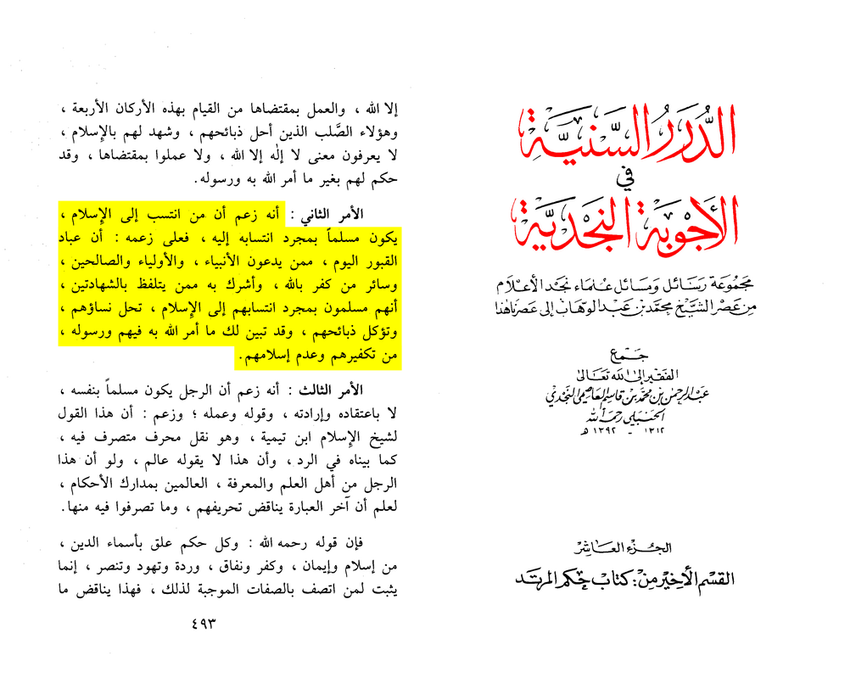
al-ʿAllāmah Abā Buṭayn said:
He claimed that whoever affiliates himself with Islām is considered a Muslim merely by this affiliation. Based on his claim, the grave worshippers of today — those who call upon the Prophets, awliyā’, the righteous, and all others who have disbelieved in Allah and committed shirk, while uttering the two testimonies (shahādatayn) — are, according to him, Muslims simply by their affiliation with Islām. Their women would thus be lawful [for marriage], and their slaughtered animals permissible [to eat].
However, it has become clear to you what Allah and His Messenger have commanded regarding such people: that they are to be declared disbelievers and not considered Muslims.
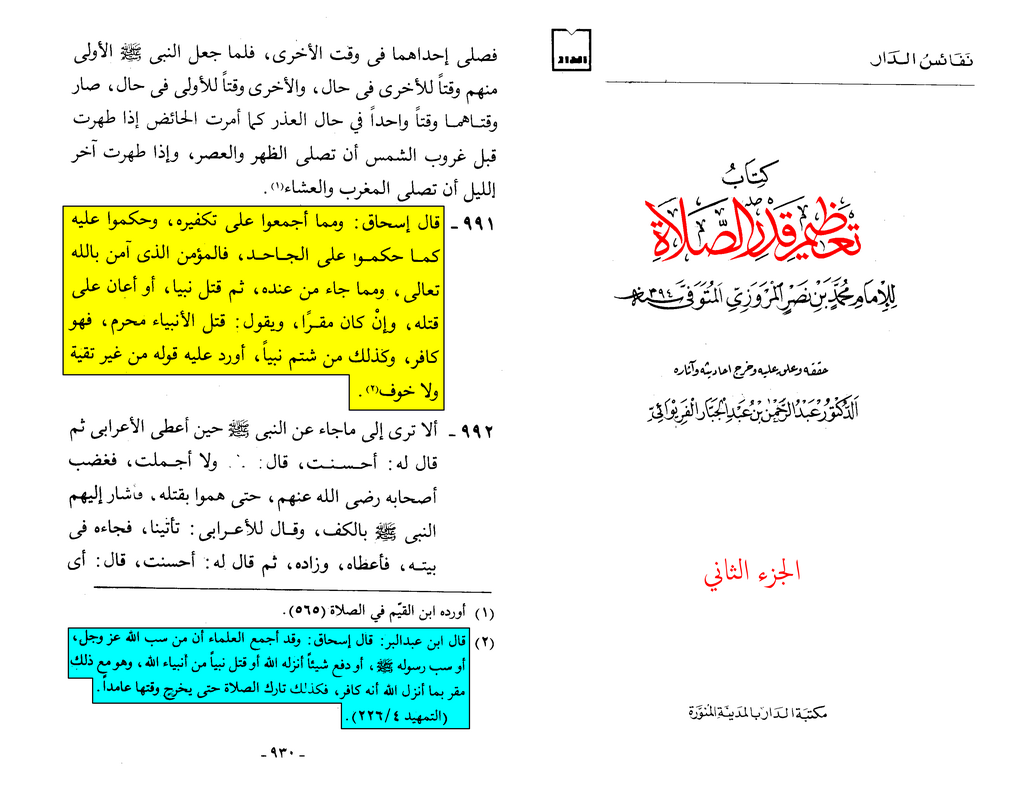
“Among the matters upon which they unanimously declared the doer a disbeliever, and ruled concerning him as they rule about the outright denier, is this: a person who believes in Allāh, Exalted, and in what has come from Him, then kills a prophet or helps in his killing—even if he admits [its prohibition] and says, ‘Killing the prophets is forbidden’—such a one is a disbeliever. And likewise whoever insults a prophet: his statement is held against him [as disbelief], so long as it was not out of taqiyyah or fear.”
“Ishaq said: The scholars have unanimously agreed that whoever insults Allah, may He be exalted, or insults His Messenger, or denies something revealed by Allah, or kills a prophet from the prophets of Allah, while still acknowledging what Allah has revealed, is a disbeliever. Similarly, the one who leaves the prayer until its time expires deliberately is also a disbeliever.” (at-Tamhīd - vol. 4, p. 226)
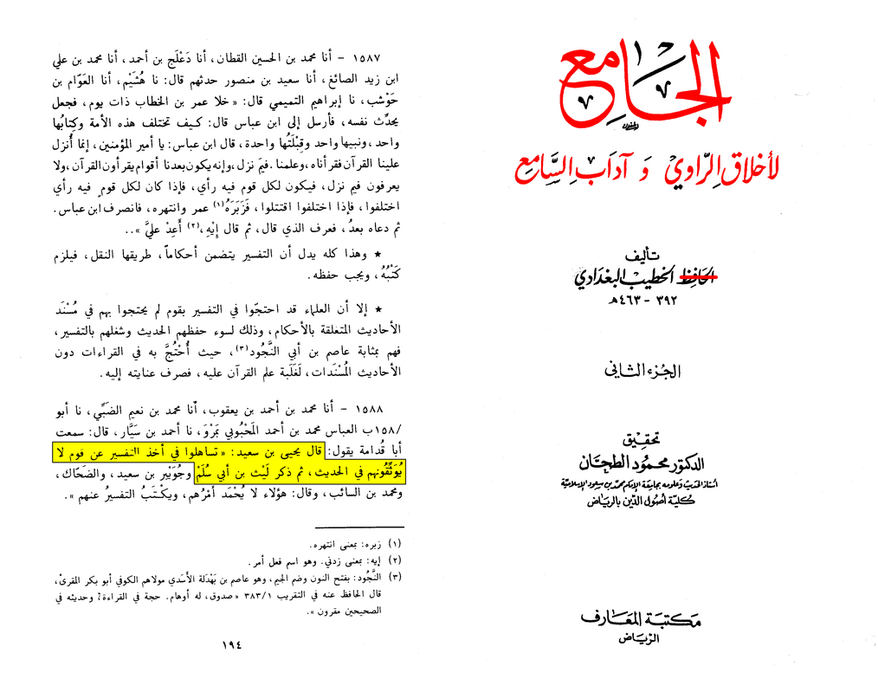
For context, al-Layth’s weakness was due to ikhtilāṭ (mix-ups in memory), but that is not a problem for this report, because al-Layth transmits from Mujāhid by a written scroll (ṣaḥīfa), not by direct hearing. Preservation (ḍabṭ) is of two types: preservation of memory (ḍabṭ al-ṣadr) and preservation by scroll (ḍabṭ al-kitāb). Ikhtilāṭ affects the preservation of memory, that is what is feared.
But when a person relies on a scroll, and the scroll is established and sound from the one he narrates from, then here we are safe from the confusion of his memory; his confusion was in his memory, not in his scroll. They did not say he altered his scrolls, nor did they describe him as an innovator, may Allāh have mercy on him. He was among the most knowledgeable regarding the rites (manāsik) when he was commended in that field. He is a learned jurist, not known for innovation, nor blamed for misguidance.
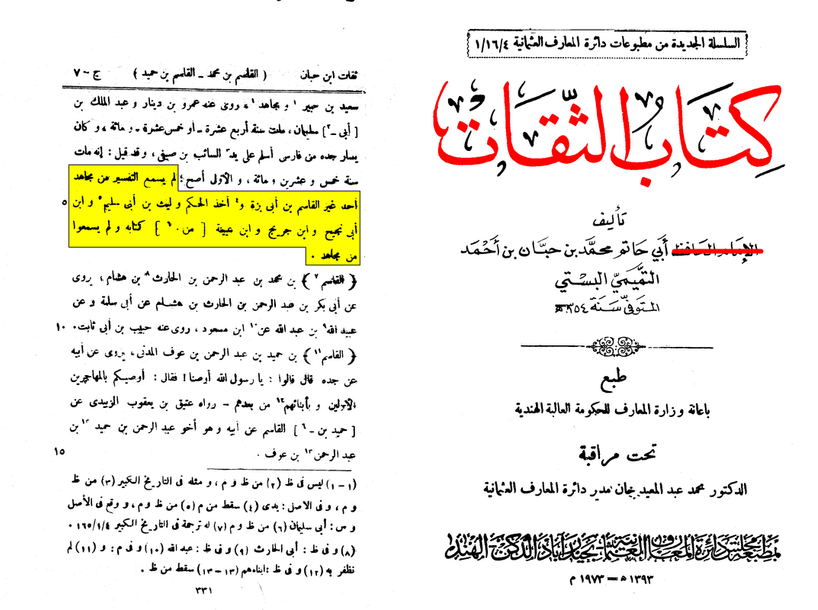
This scroll [the ṣaḥīfa from Mujāhid in tafsīr] was not something al-Layth ibn Abī Sulaym alone transmitted from Mujāhid. Rather, Ibn Ḥibbān said:
No one heard the tafsīr from Mujāhid except al-Qāsim ibn Abī Bazzah; and al-Ḥakam, al-Layth ibn Abī Sulaym, Ibn Abī Najīḥ, Ibn Jurayj, and [Sufyān] Ibn ʿUyaynah took it from his scroll; they did not hear from Mujāhid.
'They were lenient in taking tafsīr from people whom they would not deem reliable in ḥadīth,’ and he mentioned Layth ibn Abī [Sulaym].
—📚 al-Jāmiʿ li-Aḵhlāq al-Rāwī wa-Ādāb as-Sāmiʿ - p. 194, n° 1588
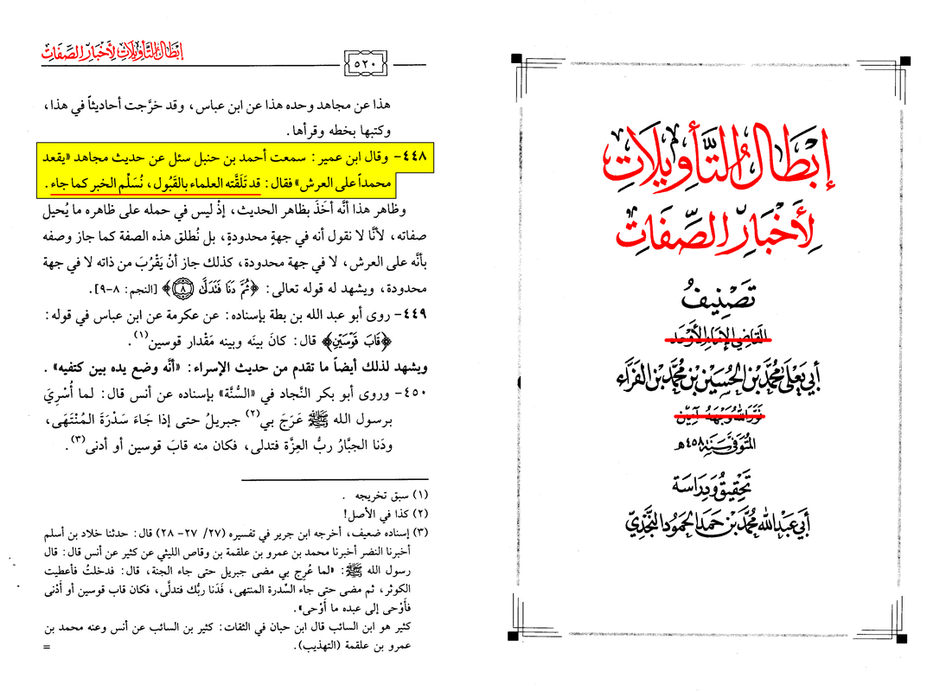
‘The scholars have collectively received it with acceptance; we submit to the report just as it came.’
—📚 Ibṭāl al-Taʾwīlāt li-Aḵbār aṣ-Ṣifāt- p. 520, n° 1588
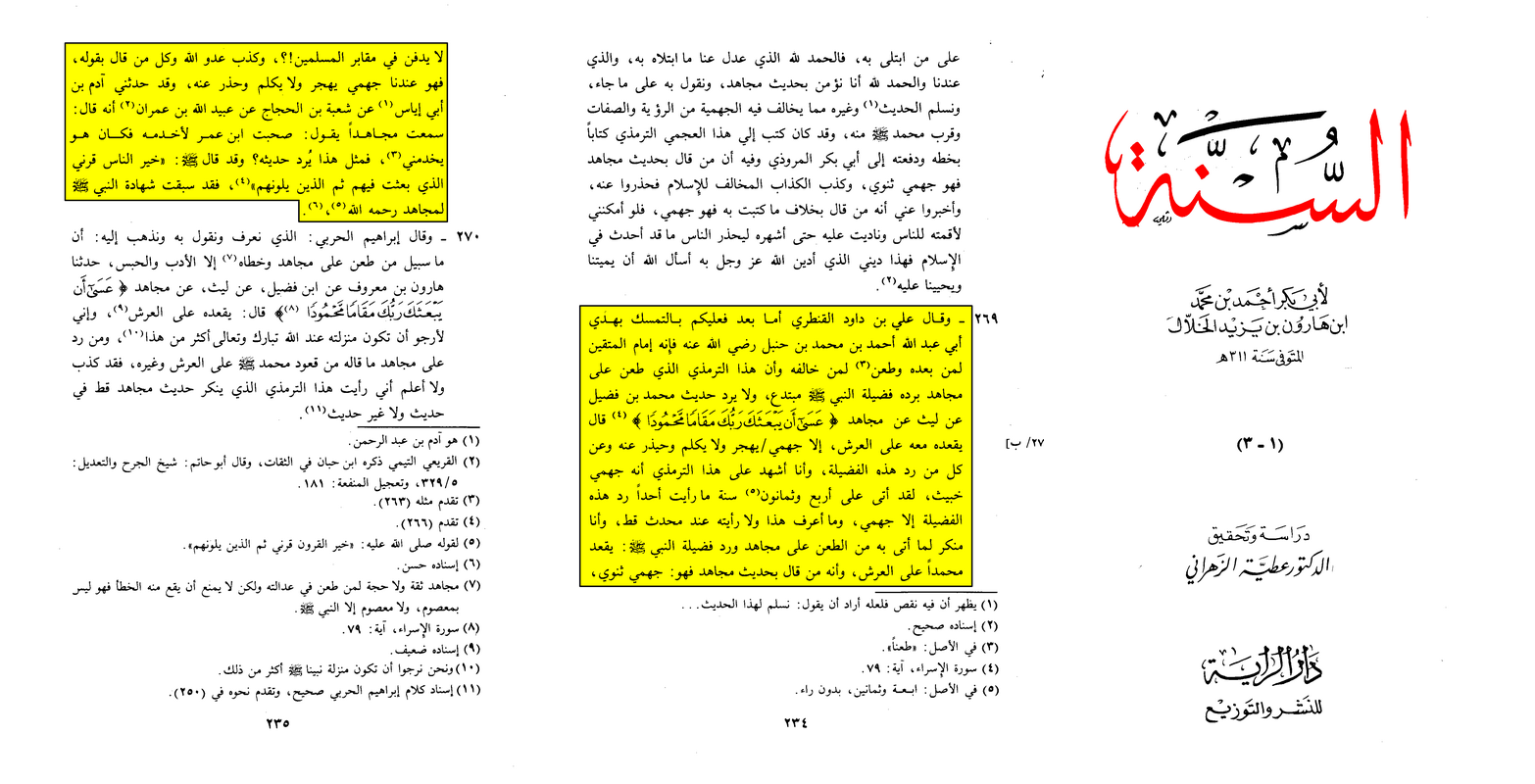
No one objected to him. And it is known that if a consensus has a basis that might seem weak in possibility, the consensus makes it stand, that is, it removes that weakness. So, with the consensus, we are safe from a defect in the text; and when consensus is established, as set down in the principles of ḥadīth (juristic and evidentiary), then, once consensus is established, one does not ask about its basis.
“As for what comes after [this], then hold fast to the guidance of Abū ʿAbdillāh Aḥmad ibn Muḥammad ibn Ḥanbal, may Allāh be pleased with him, for he was the imām of the God-fearing for those after him and in his time. And that Tirmidhī who disparaged Mujāhid by rejecting the virtue of the Prophet ﷺ is an innovator.
I renounce what he came with—of attacking Mujāhid and rejecting the virtue of the Prophet ﷺ, namely, that Muḥammad will be seated upon the Throne; and [I say] that whoever speaks regarding the ḥadīth of Mujāhid as he did is not to be buried in the graveyards of the Muslims?!
It is a lie about Allāh, the lie of the enemy of Allāh, and everyone who speaks with his statement is, in our view, a Jahmī: he is to be boycotted, not spoken to, and warned against. And Ādam ibn Abī Iyās narrated to me, from Shuʿbah ibn al-Ḥajjāj, from ʿUbayd Allāh ibn ʿImrān, that he said: I heard Mujāhid say: ‘I kept the company of Ibn ʿUmar to serve him, yet he was the one who would serve me.’ Is the like of this man’s ḥadīth to be rejected?
And the Prophet ﷺ said: ‘The best of people are my generation, then those who follow them.’ Thus the testimony of the Prophet ﷺ for Mujāhid has already preceded. May Allāh have mercy on him.”
Verdict
The statements shown have had one common thing in them, and that is the newly founded concept of Iqāmat al-Ḥujjah.
What it does without people truly understanding it is that it waters down [or downplays] the very massive and dreadful sins of shirk and kufr. The same way people use this to excuse the grave-worshippers, they could technically call Fir'aun a Muslim (we seek refuge in Allāh) because he knew that the signs were sent by Allāh when Mūsā ʿalayhi s-salām confronted him, except that he committed shirk by calling himself God, and henceforth died a kāfir, but THAT wouldn't stop these filthy excuses of human trash from excusing him.
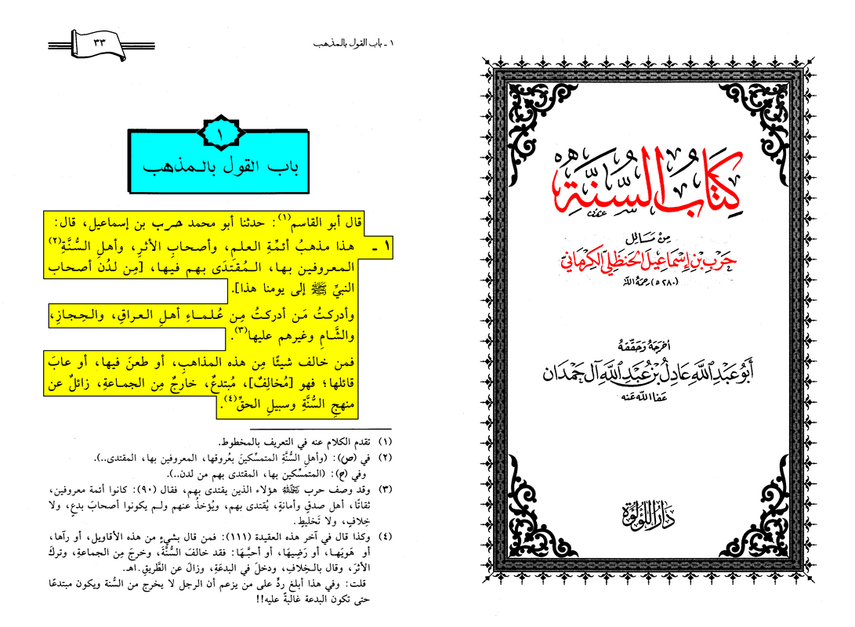
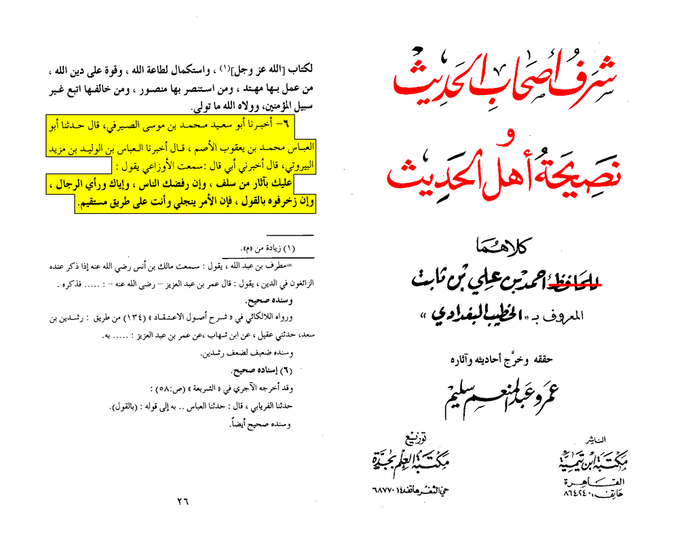
Abū Saʿīd Muḥammad ibn Mūsā al-Ṣayrafī informed us; he said: Abū al-ʿAbbās Muḥammad ibn Yaʿqūb al-Aṣamm narrated to us; he said: al-ʿAbbās ibn al-Walīd ibn Mazīd al-Bayrūtī informed us; he said: my father informed me; he said: I heard al-Awzāʿī say:
“Cling to the narrations of those who came before, even if people reject you; and beware the opinions of men, even if they adorn them with fine words. For the matter will become clear, and you will be upon a straight path.”
— 📚 Kitāb Sharaf Aṣḥāb al-Ḥadīth, p. 26
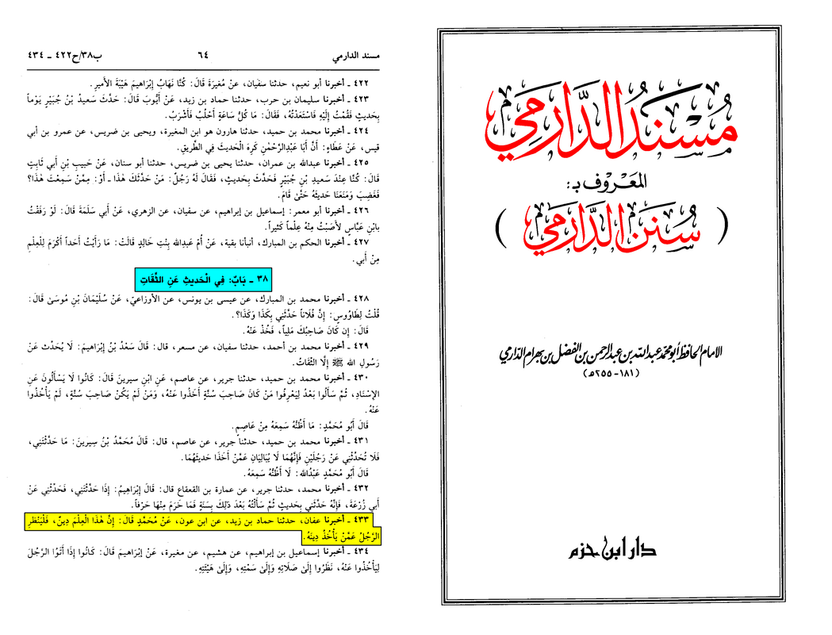
ad-Dārimī narrated in his Musnad:
ʿAffān informed us; Ḥammād ibn Zayd narrated to us, from Ibn ʿAwn, from Muḥammad [ibn Sīrīn], who said:
“Indeed, this knowledge is religion; so let a person look carefully from whom he takes his religion.”
— 📚 Musnad ad-Dārimī (or Sunan ad-Dārimī), p. 64
My message to anyone who wishes to refute this, you can't bring anything except that something else will declare your Imām a kāfir. If you try to bring contemporaries, then you are completely lost. If you try to bring people after the Salaf, for example adh-Dhahabī on al-Maqām al-Maḥmūd, you won't be able to because he accepted and affirmed the narration. You won't ever be able to bring anything on Iqāmat al-Ḥujjah because it is already established from HIM, and all the evidence I brought is already enough to declare him a kāfir.
All I can say to you filthy people, O Madākẖilah, is to cope and seethe.
All praise is due to Allāh, who has completed our religion, perfected His favor upon us, made the truth clear to those who seek it, and rendered all falsehood void no matter how adorned it may be, and may peace and blessings be upon the one who conveyed the message and fulfilled the trust, and upon his family and his companions until the Day of Judgement.